
Savoring the Douro Valley: Wine Travel in Portugal's Oldest Wine Region

Updated: May 1
Where terraced vineyards cascade toward a copper river and centuries-old estates pour wines that taste unmistakably of the land.
There are places in the world where the landscape and what grows from it are inseparable — where the wine in your glass is essentially a portrait of the hills around you. The Douro Valley in northern Portugal is one of those places.

When you arrive here for the first time, something shifts. The train from Porto curves east along the riverbank, the schist cliffs rising on either side, and slowly the valley opens into something that feels ancient and alive all at once.
The World's First Demarcated Wine Region

The Douro Valley was the first wine region in the world to be officially demarcated and regulated, a distinction established in 1756 under the Marquis de Pombal. It spans approximately 250,000 hectares across three distinct sub-regions: Baixo Corgo in the west, Cima Corgo in the center — anchored by the historic towns of Peso da Régua and Pinhão — and the wild, remote Douro Superior to the east. In 2001, UNESCO recognized the entire cultural landscape as a World Heritage Site.
The region's schist soils and continental climate — cold winters, intensely hot and dry summers — create conditions of profound stress for the vine, and it is precisely that stress that produces wines of such depth and concentration. This is where Port wine was born, and where an increasingly celebrated range of bold dry reds and delicate whites now share the stage.
Between Trips Travel recommends spending a minimum of five nights in the Douro Valley to allow meaningful time in at least two sub-regions — the intimate elegance of the Cima Corgo and the raw, dramatic beauty of the Douro Superior.
The Landscape as Its Own Reward
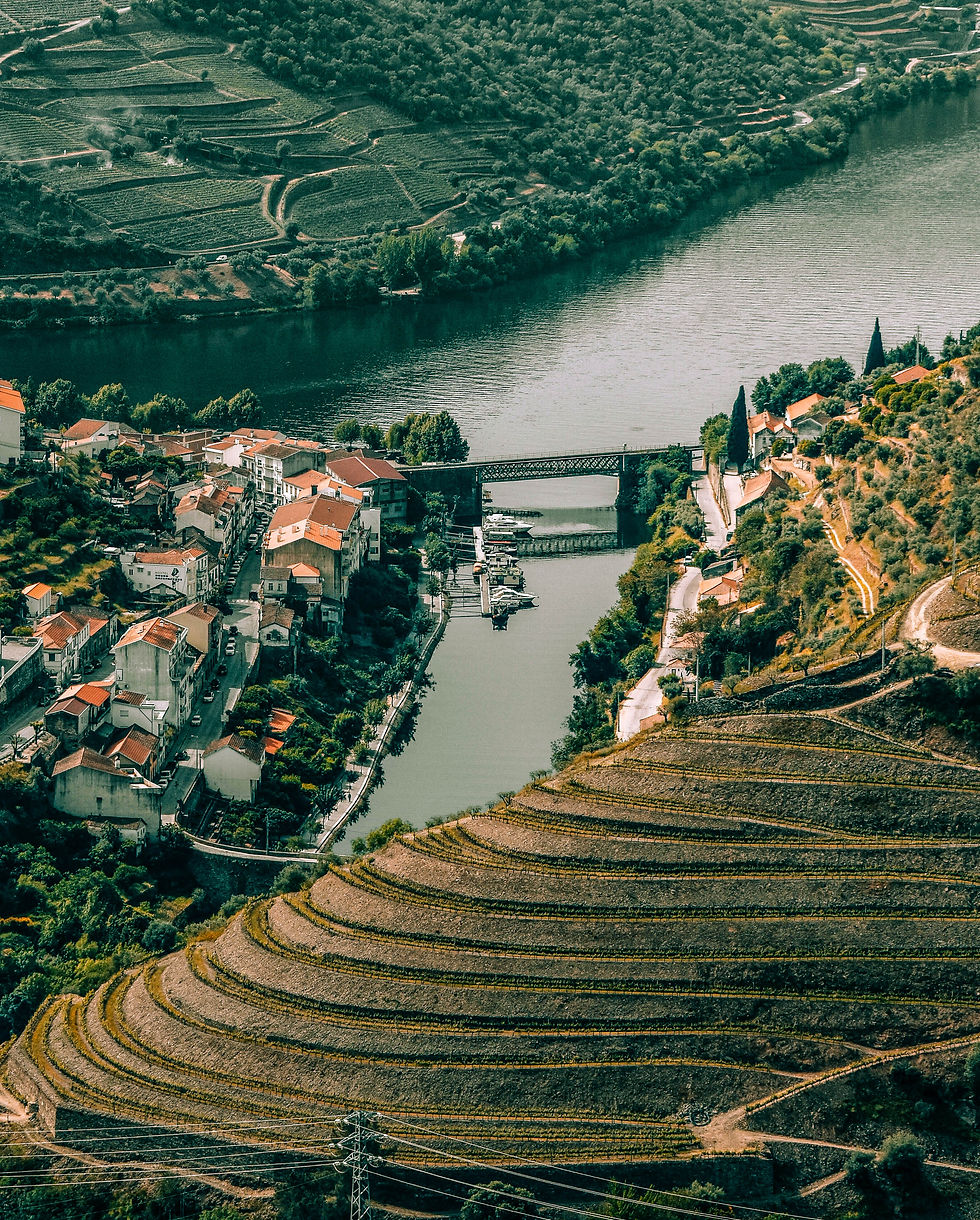
The Douro Valley is not simply a backdrop for wine. It has a way of becoming the unexpected revelation — the thing you didn't know you were coming for.
The terraced vineyards here are not gentle slopes — they are vertical monuments, carved by hand into schist over centuries, stacked along hillsides so steep that even harvesting requires extraordinary effort. From the deck of a boat or the window of the Linha do Douro train, the full scale of that human endeavor is reflected back at you in the river below.
Picture yourself on a quiet terrace at the end of a long afternoon, the sun dropping behind the hills across the water, a glass of aged Tawny Port warming slowly in your hands, the valley filling with shadow and birdsong. That is the Douro at its most essential.
Estates That Define the Valley
At the recent FINE wine tourism conference in Valladolid, Spain, I had the privilege of sitting with several of the Douro's most compelling producers — conversations that deepened an already long-standing conviction that the true story of this valley is told behind the gates of its estates.
The journey east begins in Vila Nova de Gaia, where Ramos Pinto — founded in 1880 — opens its historic cellars and the Adriano Ramos Pinto Museum, with its remarkable collection of Art Nouveau advertising posters from the late 19th century, for a beautifully layered introduction to the Port wine story. Nearby, Burmester — founded in London in 1750 and one of the region's most enduring houses — opens its own Gaia cellars for guided tours and tastings overlooking the river.
Quinta do Vallado, established in 1716 on the banks of the Corgo River near Peso da Régua, carries one of the Douro's most storied lineages: the estate once belonged to the legendary Dona Antónia Adelaide Ferreira and remains in the hands of her descendants today. Their 19-room wine hotel — housed partly in an 18th-century manor built of local schist — is one of the finest places to wake up inside the valley.

Quinta do Crasto, situated on a privileged promontory between Régua and Pinhão, has ranked among the Top 20 World's Best Vineyards for six consecutive years, landing 15th in the 2024 edition. The 135-hectare estate — whose name echoes its Roman fortress past — welcomes overnight guests in four beautifully appointed rooms, offers vineyard picnic experiences at altitudes between 150 and 500 metres, and hosts evening wine dinners in a setting that feels genuinely timeless.
In Tabuaço, approximately 140 kilometres east of Porto, Quinta de São Luiz — the production home of the Kopke label — pairs schist-terraced vineyards and deep winemaking heritage with a restaurant helmed by Chef Vítor de Oliveira, whose menu draws directly from the flavors and traditions of the Douro river valley.
The journey ends, fittingly, at its most remote point. Quinta de Ervamoira — a Ramos Pinto estate located within the Côa Valley Archaeological Park in the Douro Superior — offers outdoor tastings in a UNESCO World Heritage territory, paired with access to an on-site archaeological museum housing artifacts from the property's own excavations. The experience unfolds around a single dining table in the warmth of the estate house, with the silence of the wider valley all around. Quinta do Vallado's second property, Casa do Rio, sits among organic vineyards nearby — a quiet reminder that the best estates in this valley have roots that reach from the river's mouth to its farthest edge.
On the Water
The Douro Valley may first reveal itself to you from the deck of a river cruise ship — and it is a genuinely extraordinary introduction. The terraced vineyards, seen at water level as the ship moves slowly eastward, offer a scale and continuity that no road or train window quite replicates.
No understanding of the Douro is complete without time on the river. The rabelo boats that once carried barrels of Port downriver to the cellars of Gaia are a piece of living history, and their descendants offer one of the most intimate ways to move through the valley.

PipaDouro brings a vintage sensibility to Douro river travel — their classic wooden vessels, including the Friendship I, a 1957 English-built 66-foot yacht, and the Pipadouro II, a 1965 vessel inspired by American Chris-Craft designs, move through the valley at a pace that feels suited to the landscape. These are not mass-market sailings; they are custom wine journeys built around a bottle and a view.
Combining two or three nights aboard with estate stays ashore gives you both the scale of the valley from the water and the soul of it from within the vines.
The Douro Valley: Questions Worth Asking
What is the best time of year to visit the Douro Valley for wine travel?
Late September through October is the most celebrated season — the harvest transforms the valley, filling it with the scent of fermenting grapes as the hills turn gold and copper. Spring, from March through May, brings wildflowers, cooler temperatures, and vivid green landscapes. Between Trips Travel considers both ideal windows for Douro Valley wine travel, depending on whether you prefer harvest energy or unhurried beauty.
How long should I spend in the Douro Valley?
A minimum of five nights allows meaningful time in at least two sub-regions. Three nights near Pinhão in the Cima Corgo and two nights further east — at an estate like Quinta do Vallado's Casa do Rio or Quinta de Ervamoira — provides both depth and contrast without rushing.
Do I need to book winery visits in advance?
Yes. Estates like Quinta do Crasto and Quinta de Ervamoira operate private, curated experiences that require advance reservation. The most intimate encounters — vineyard picnics, estate dinners, private cellar access — are not available on short notice at the properties that offer them most memorably.
Is a river cruise the right way to experience the Douro Valley?
It depends on the kind of journey you want — and for many, a river cruise is the most effortless way to experience the valley.
Traditional river cruise lines offer the ease of unpacking once and following a curated itinerary — moving port to port with excursions built in, the valley unfolding over seven or eight days from the comfort of your ship.
For those who want a more intimate, wine-focused experience on the water, boutique operators like PipaDouro offer smaller vintage vessels and custom itineraries built entirely around the wines and estates of the valley. Both are valid entry points; the right choice depends on how independently you want to move.
Your Douro Valley Wine Travel, Thoughtfully Planned
The Douro rewards you for resisting the temptation to rush. A well-crafted journey moves slowly through the sub-regions — lingering over a vineyard lunch, spending a morning in an ancient cellar, ending long evenings with a glass of Vintage Port and the sound of the river below.

The detail that elevates Douro Valley wine travel from enjoyable to transformative is often invisible on paper: the estate that opens a cellar door otherwise closed to visitors, the winemaker who sets aside a bottle from a year not on the tasting menu. That is what we help you discover.
The Douro does not announce itself. It reveals itself — slowly, over a long afternoon, through the third glass of a wine made from vines older than most countries. That is the rhythm of this valley, and it is worth surrendering to completely.
The valley is waiting.


