
Ribera del Duero Wine Tourism: Where Every Winery Tells a Different Story

Updated: May 1
Six wineries in two days—and each one felt like entering a completely different world

Six wineries in two days. I expected them to blur together. How different could they really be? Same region, same Tempranillo grape, same process of turning fruit into wine. By the second afternoon, I thought, they'd all start to feel familiar. Ribera del Duero had other plans.
Each stop revealed something utterly distinct—not just in the wines we tasted, but in everything surrounding them. A 12th-century monastery where silence settled over our group like a physical presence. A working farm where we walked among a thousand head of wild boar. Cellars carved beneath a medieval castle. A wine library unlike anything I'd seen. A winery mid-transformation where we tasted wines that don't yet exist in their finished form.
This is what sets this region apart: extraordinary variety concentrated in a space compact enough to explore without exhausting yourself in transit. Spain's third most visited wine route offers depth without sprawl, innovation alongside centuries of tradition, and experiences that transcend what ends up in your glass.
A River Valley Worth Understanding
Ribera del Duero stretches 115 kilometers across four provinces in Castilla y León—Burgos, Soria, Segovia, and Valladolid—following the Duero River through landscapes that shift from rolling vineyard country to dramatic hillside terrain. The region encompasses over 27,000 hectares of vineyards and nearly 316 wineries producing some of Spain's most celebrated wines.
The wineries we explored were concentrated within an easy touring range. No exhausting drives between experiences, no sense of rushing to make the next appointment—time to absorb each place before moving to the next, watching almond trees bloom white against dormant vines, their delicate blossoms softening the early March landscape.
Tempranillo—known locally as Tinto Fino—thrives here in extreme continental climate where brilliant sun-filled days give way to cool, humid nights. This temperature swing creates slow, perfect ripening, grapes developing the deep color and structure that make these wines distinctive even among Spain's prestigious appellations.
Where Architecture Honors Tradition

Ribera del Duero's wine route includes wineries designed by two Pritzker Prize-winning architects—Richard Rogers at Bodegas Protos and Norman Foster at Bodegas Portia—making it one of the few wine regions in the world where architectural tourism rivals the wines themselves.
Bodegas Protos sits at the base of Peñafiel Castle, its distinctive parabolic vaults designed by Pritzker Prize-winning architect Richard Rogers rising from the landscape. But the real magic happens beneath—in aging cellars carved directly under the castle itself, where over two kilometers of underground tunnels hold wines in conditions unchanged for centuries. Founded in 1927 by eleven visionary winemakers, Protos helped establish Ribera del Duero as a Denomination of Origin (D.O.) in 1982.

Bodegas Portia brought Norman Foster—the architect behind Wembley Stadium and countless iconic structures—to wine country. His design elevates the production room above the vineyard itself, creating views that blur the line between building and landscape. Inside, the wine library reimagines bottle storage as architectural installation. We had lunch overlooking the barrel room through floor-to-ceiling glass, the moody space lit by red light tracing the walls.

Hotel & Spa Arzuaga/Bodega Arzuaga proved wine tourism can be a complete resort experience. The 96-room property integrates a working winery, spa, and Michelin-starred restaurant called Taller, which built its reputation on estate game. That game comes from Finca La Planta, where we walked among deer and over a thousand head of wild boar across grounds anchored by an 18th-century Provençal-style country house and an 800-year-old oak. Beyond traditional tastings, Arzuaga presents wine fermentation as visual theater through illuminated projections.

Condado de Haza takes a different approach. Here, the Fernández Rivera family—whose matriarch and patriarch started with a 16th-century stone winery in 1972 and helped create the appellation—built a Castilian château that burrows into a hillside. Aging cellars tunnel nearly 30 meters deep beneath brick vaulted ceilings, their warm terracotta curves holding wines in conditions perfected across generations. Now run by the family's granddaughters, the estate practices 100% organic farming across 200 hectares. Inside, historic stone and brick arches give way to a contemporary tasting room where jewel-tone velvet and rich wood create intimate luxury.
Abadía Retuerta LeDomaine stopped us in our tracks. This 12th-century monastery, founded in 1146, was meticulously restored into a luxury hotel that earned three Michelin Keys—among the world's most distinguished properties. We walked through cloisters and the ancient church on our way to lunch in what was once the sacristy. We even spotted the stork who had built her nest atop the monastery tower, a bird that returns each year. The property encompasses 700 hectares, its vineyards so distinctive they earned their own Protected Designation of Origin (PDO) in 2022. The Michelin-starred Refectorio serves avant-garde Castilian cuisine in the former monks' dining hall.
Bodegas Valdubón gave us something entirely different: transformation revealed in real time. Founded in 1997 by the Ferrer family—whose winemaking legacy stretches back to 1616—Valdubón had just completed a €2.3 million renovation focused not on volume but precision. Working with Xavier Ausás, one of Spain's most respected winemakers, the sixth-generation family invested in six new 8,000-liter tanks for plot-specific vinifications, advanced climate control, and sustainability infrastructure including 500 solar panels and a water treatment plant protecting the Riaza and Duero river basins. The completion had been announced just days before our visit. Laura guided us through the transformation, pouring raw wine straight from one of the six new tanks designed for plot-specific vinifications.
The Wider Canvas
Culinary experiences in Ribera del Duero range from Michelin-starred dining at Abadía Retuerta LeDomaine's Refectorio restaurant to traditional lechazo (slow-roasted milk-fed lamb) at family-style lunches throughout the region.
The wines themselves showcased breadth beyond what you might expect. While Tempranillo dominates Ribera del Duero, many family wine groups maintain properties across Spain's premier appellations. At tastings, we explored not just powerful reds from the region but elegant whites from Rueda and Rías Baixas, sparkling Cavas from Penedès, and Rioja Reservas—all produced by the same families whose Ribera del Duero wineries we were visiting.
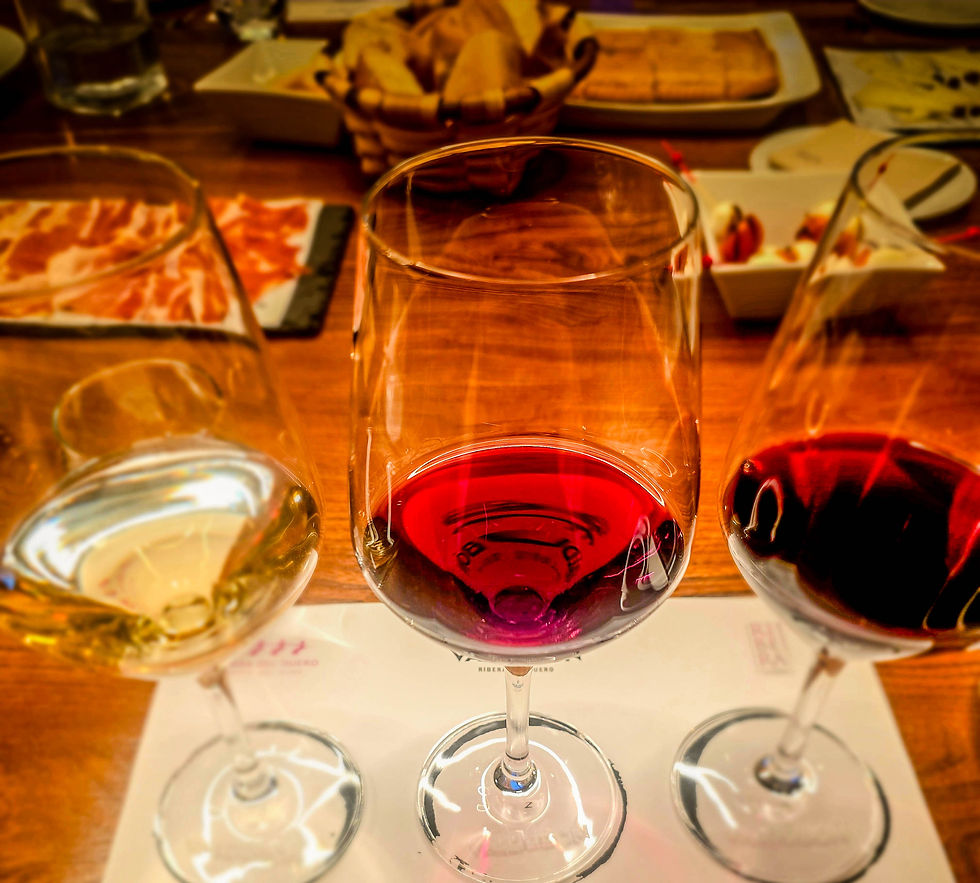
The food matched this variety. At Abadía Retuerta LeDomaine, Refectorio's Michelin-starred cuisine presented Castilian ingredients through an avant-garde lens. While at Hotel Arzuaga, Taller built its reputation on estate game. Traditional lechazo—slow-roasted milk-fed lamb—appeared at family-style lunches. Casual tapas at Valdubón—featuring Spain's renowned jamón and artisan cheeses, including a remarkable truffle cheese—proved wine country dining isn't always formal.
And then there were experiences beyond eating and drinking: the profound quiet of monastery corridors, hillside vineyard walks with valley views stretching to the horizon, discovering that both Condado de Haza and Arzuaga are planning eclipse viewing experiences for August 12, 2026, when the first total solar eclipse visible from the Iberian Peninsula in over a century will pass directly overhead. (Both will sell out in advance, so let us know if you are interested!)
Ribera del Duero Wine Tourism: Worth the Journey
Wine expertise isn't required here. The landscapes themselves reward anyone drawn to beauty and craft: hillside vineyards beneath castle silhouettes, stone villages unchanged across centuries, terrain carved by the Duero and defined by dramatic elevation. The architecture could captivate someone who never touches alcohol. The food draws travelers focused on culinary excellence. The history speaks to those fascinated by how places evolve across centuries.
Between Trips Travel recommends a minimum of three nights in Ribera del Duero to allow unhurried exploration of four to six estates, with a stay at a property like Abadía Retuerta LeDomaine anchoring the experience in the region's history and cuisine.
Walking among wild boar at Finca La Planta, exploring a 12th-century monastery, understanding why Richard Rogers chose those particular parabolic curves—these experiences transcend the beverage industry. They're about craft, vision, place, and the countless decisions that turn raw materials into something worthy of contemplation.
Ribera del Duero welcomes travelers seeking substance over superficiality, depth over itinerary boxes to check. It offers the kind of wine tourism that changes how you understand not just wine, but the relationship between people and the land they tend.
The Gift of Variety
Six wineries in two days. Each one utterly distinct. That variety is the gift of Ribera del Duero wine tourism—monastery silence giving way to wildlife walks giving way to castle cellars giving way to renovation reveals, all within a compact region worthy of its own journey.
Before You Follow the Wine Road
When is the best time to visit Ribera del Duero for wine tourism?
Late September through October is harvest season, when grape picking is underway and wineries are at their most dynamic. Spring — particularly March through April — offers vineyard walks amid blooming almond trees with fewer visitors. The region is accessible year-round, though midsummer heat across the Castilla y León plateau can be intense.
How far is Ribera del Duero from Madrid?
Ribera del Duero lies approximately 150 to 180 kilometers north of Madrid, reachable by car in under two hours. The wine route's wineries are concentrated enough that a self-drive itinerary is practical, with Aranda de Duero serving as a useful base.
What makes Ribera del Duero wines distinctive from other Spanish appellations?
Tinto Fino — the local name for Tempranillo — grows at elevations between 700 and 900 meters above sea level, higher than most Spanish wine regions. The extreme continental climate, with warm days and sharply cool nights, creates slow, even ripening that produces the deep color, structure, and concentration Ribera del Duero is known for internationally.
Do I need a wine background to enjoy this region?
None required. Architectural tours at Bodegas Portia, wildlife walks at Finca La Planta, and Michelin-starred dining at Abadía Retuerta LeDomaine offer compelling reasons to visit entirely apart from the wines. Between Trips Travel designs Ribera del Duero itineraries for travelers at every level — from first-time wine tourists to serious collectors seeking private cellar access.
Can I stay overnight within the wine region?
Several estates offer exceptional accommodations. Abadía Retuerta LeDomaine, a restored 12th-century Premonstratensian monastery awarded three Michelin Keys, is among the most distinguished wine hotel experiences in Spain. Hotel Arzuaga offers 96 rooms, a full spa, and the Michelin-starred Taller restaurant within a working vineyard estate.
The Ribera del Duero Wine Tourism Experience You'll Actually Remember

We craft Ribera del Duero experiences that honor this diversity—stays at properties like Abadía Retuerta LeDomaine or exceptional vineyard estates, access to winemakers during transformation moments, meals that showcase culinary depth, and the kind of thoughtful pacing that lets each experience breathe before moving to the next.
The stork will return to her monastery nest. The almond trees will bloom again. And somewhere in those deep tunnels, in monastery cellars, in climate-controlled tanks designed for tomorrow's wines, this river valley continues the patient work of turning grapes into something that rewards attention.
This wine, this valley - yours to discover.

