
5 Extraordinary UNESCO World Heritage Sites Across the UK & Ireland

Updated: May 4
Where ancient stones meet Georgian elegance and wild Atlantic beauty.
Some landscapes feel like they've been waiting for you—places where history runs so deep you can sense it in the stones beneath your feet, where medieval monasteries cling to Atlantic cliffs, and where Georgian crescents curve with such perfection they seem almost inevitable.
The UK and Ireland shelter UNESCO World Heritage Sites that span five thousand years of human story—from Neolithic passage tombs aligned to winter solstice to Romantic poets' lakes, from Roman baths still steaming after two millennia to island monasteries where monks copied manuscripts while Vikings ruled the seas.
These aren't museum pieces preserved behind glass. They're living places where heritage and contemporary life interweave, where you can soak in thermal waters the Romans discovered, walk castle ramparts where Scottish kings plotted, and stand in chambers built before the pyramids existed.
The United Kingdom holds 33 UNESCO World Heritage Sites — among the highest concentrations in the world — while Ireland recognizes two: Brú na Bóinne in County Meath and Skellig Michael off the Kerry coast. Together, the five sites in this article span more than five thousand years of human civilization. Bath, inscribed by UNESCO in 1987, is England's most complete surviving Roman and Georgian city, its architectural fabric largely unchanged since the 18th century.
Bath: Where Romans and Georgians Perfected Elegance
Long before Jane Austen's heroines paraded along Bath's elegant streets, Roman legionaries soaked in the naturally heated waters rising from deep beneath the city. The temple complex they built around these sacred springs—dedicated to the goddess Sulis Minerva—still flows at 46 degrees Celsius, just as it did two thousand years ago.
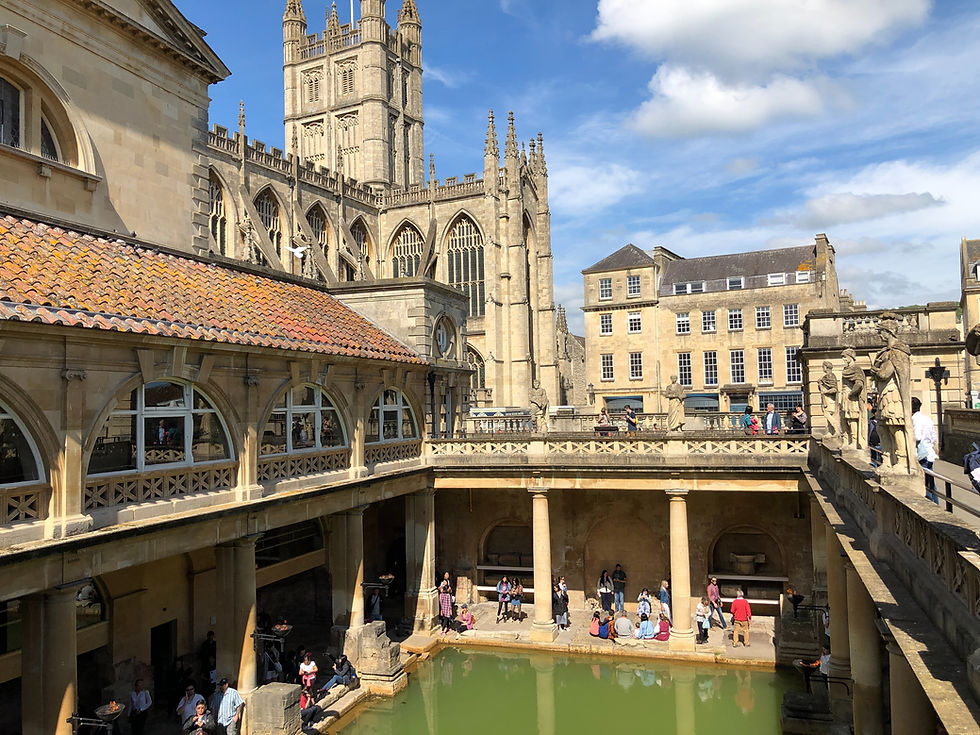
But Bath's genius lies in how it layered beauty upon beauty. When 18th-century society made it England's most fashionable spa town, architects John Wood the Elder and Younger created the Royal Crescent—thirty terraced houses forming a perfect arc overlooking manicured lawns. Honey-colored Bath stone glows golden in evening light. The Circus, the Assembly Rooms, Pulteney Bridge spanning the Avon—everywhere you turn reveals another architectural jewel.
The modern Thermae Bath Spa lets you experience what drew Romans and Georgians alike: floating in rooftop pools while Bath's spires and crescents spread below, steam rising into cool British air. It's a rare chance to participate in a tradition stretching back millennia.
Edinburgh: A Capital Built on Drama
Edinburgh doesn't just contain history—it's constructed from it. Edinburgh's Old and New Towns were jointly inscribed as a UNESCO World Heritage Site in 1995, recognized for an architectural heritage spanning six centuries and an urban landscape that remains among the most dramatically intact in Europe.
The Old Town tumbles down the ridge from the castle, its medieval closes and wynds creating a vertical maze of stories. The New Town spreads in Georgian symmetry across the valley, its boulevards and crescents demonstrating Enlightenment ideals in stone.
Edinburgh Castle dominates from its volcanic crag, where Scottish kings resided and the Honours of Scotland—the oldest crown jewels in Britain—have rested for centuries.
Walk the Royal Mile from castle to palace, and you're following the path of monarchs, reformers, and revolutionaries. Duck into narrow closes and discover hidden courtyards where 18th-century residents lived stacked seven stories high.

The New Town reveals different ambitions—planned perfection with Princes Street, George Street, and Queen Street running parallel, connected by elegant squares. This is where Scottish Enlightenment thinkers like David Hume and Adam Smith walked, where Robert Louis Stevenson grew up, where innovation and tradition achieved rare balance.
Beyond the architecture, Edinburgh pulses with living culture. Literary festivals, Hogmanay celebrations, the world's largest arts festival each August. This UNESCO recognition honors not just buildings but the continuous creative spirit that has always defined Scotland's capital.
Where to Stay: The Balmoral commands Princes Street with Victorian grandeur and Michelin-starred dining, its clock tower a city landmark. For Georgian elegance in the heart of the New Town, InterContinental Edinburgh The George occupies an iconic building on one of the capital's most prestigious streets—welcoming guests with the same hospitality that hosted Robert Burns and Sir Walter Scott over two centuries ago. Further afield but worth the journey, Gleneagles offers legendary luxury amid Perthshire's hills—championship golf, falconry, and the kind of service that defines Scottish hospitality at its finest.
The Lake District: Where Poetry Meets Peak
William Wordsworth called the Lake District "the loveliest spot that man hath ever found," and even accounting for poetic license, he wasn't exaggerating. Sixteen lakes nestle between fells and valleys, their waters reflecting skies that shift from steel to sapphire within minutes. Stone walls march up impossible slopes. Villages of slate and stone cluster around medieval churches.
This became England's first national park and eventually earned UNESCO recognition not just for natural beauty but for the cultural landscape humans created here over millennia—the distinctive Herdwick sheep bred for these hills, the dry-stone walls that pattern the fells, the conservation movement Wordsworth himself helped pioneer.
The Lake District National Park covers 2,362 square kilometers in northwestern England and was inscribed as a UNESCO World Heritage Site in 2017 — among the most recently designated sites in the country — recognized for its cultural landscape: ten thousand years of farming, grazing, and settlement layered across spectacular terrain.

Windermere stretches longest, its shores dotted with Victorian villas and steamer landings. Ullswater curves through dramatic scenery that inspired some of Wordsworth's finest verses. Wastwater plunges England's deepest, overlooked by Scafell Pike's summit. Each lake offers different character, different stories.
Walking remains the best way to experience this landscape—whether gentle rambles through Grasmere's woods or challenging scrambles up Helvellyn's ridges. The changing light rewards patience: morning mist lifting from water, afternoon sun illuminating distant peaks, evening's long shadows stretching across valleys.
Skellig Michael: Where Earth Meets Sky
Eight miles off Ireland's Kerry coast, a jagged pyramid of rock rises 714 feet from the Atlantic. Skellig Michael's profile seems almost too dramatic to be real—sheer cliffs, wheeling seabirds, waves exploding against ancient stone. That monks chose to build a monastery here in the 6th century speaks to either extraordinary devotion or slight madness. Perhaps both.

Climbing the 618 stone steps they carved into the cliff face feels like ascending to another world. The monastery sits on a saddle between peaks, its beehive huts constructed without mortar yet still weatherproof after fourteen centuries. Monks lived here in isolation, copying manuscripts, praying, surviving Atlantic storms that must have seemed apocalyptic.
The island's remoteness protected it from Viking raids that devastated mainland monasteries.
Today, that same remoteness protects it still—visitor numbers are strictly limited, weather often prevents landings, and the experience remains raw and humbling. This is a UNESCO World Heritage Site where nature and human determination created something that transcends both.
Skellig Michael was inscribed as a UNESCO World Heritage Site in 1996, recognized for the extraordinary preservation of its early Christian monastery — one of the most intact examples of early medieval monastic settlement anywhere in Europe. Global recognition from Star Wars filming has drawn more travelers to seek permits, but if you're fortunate enough to secure permits and favorable weather, the journey reveals why early Christian monks sought places where earth and heaven felt close.
Brú na Bóinne: Older Than the Pyramids
The River Boyne curves through Ireland's Meath countryside, creating a bend where Neolithic people five thousand years ago built a monument complex of astonishing sophistication.
Brú na Bóinne — meaning "the bend of the Boyne" — was inscribed as a UNESCO World Heritage Site in 1993 and encompasses three major passage tombs: Newgrange, Knowth, and Dowth, along with approximately 90 associated monuments dating to around 3200 BC. Newgrange, the most famous tomb here, predates both the Egyptian pyramids and Stonehenge. Yet calling it merely a tomb undersells its purpose.

The circular mound—nearly 280 feet across—was constructed with such precision that each winter solstice, sunlight penetrates the roof-box above the entrance, travels down the 60-foot passage, and illuminates the inner chamber for exactly seventeen minutes. Five millennia later, this alignment still functions perfectly.
The engineering astounds: stones weighing tons transported from mountains miles away, passages corbelled without collapse, the white quartz facade that once made the mound gleam like a beacon. The artistry equally impresses—spiral carvings that may represent the sun, the seasons, or concepts we can barely imagine.
Standing in that chamber during winter solstice as dawn light creeps inward—an experience offered by lottery—connects you to ancestors who understood celestial mechanics, who built monuments to outlast empires, who left questions we're still trying to answer.
Before You Follow the Stones
How many UNESCO World Heritage Sites are there in the UK and Ireland?
The United Kingdom holds 33 UNESCO World Heritage Sites spanning prehistoric monuments, Georgian cityscapes, industrial landscapes, and natural wonders. Ireland holds two: Brú na Bóinne in County Meath and Skellig Michael off the Kerry coast. Between Trips Travel designs itineraries that connect multiple sites into a single, cohesive journey rather than a checklist of stops.
How do you reach Skellig Michael, and how far in advance should permits be arranged?
Licensed boats depart from Portmagee and Ballinskelligs on the Iveragh Peninsula in County Kerry — a crossing of approximately 12 kilometers that takes 45 to 60 minutes depending on sea conditions. Visitor numbers are capped at 180 per day, landings are permitted only from May through October, and weather cancellations are common. Permits should be secured months in advance; many travelers build a flexible buffer day into their Kerry itinerary to account for conditions.
When is the best time to visit the Lake District?
Late May through June and September through early October offer the most reliable combination of weather and manageable crowds in the Lake District. July and August bring peak visitors; January through March delivers dramatic light and near-solitude on the fells, though some smaller properties and lake steamers operate reduced schedules.
How do visitors experience the Newgrange winter solstice alignment?
Access to Newgrange at Brú na Bóinne is managed year-round through the Brú na Bóinne Visitor Centre. The winter solstice illumination — when dawn light travels the 19-meter passage and fills the inner chamber for approximately 17 minutes — is allocated by lottery. Roughly 30,000 people apply each year for the 50 available places across the five mornings around December 21st.
Experiencing UNESCO World Heritage Sites with Depth
These five destinations share something beyond UNESCO designation: they reward slow exploration. Bath reveals itself over days, not hours—discovering hidden alleyways, attending concerts in the Assembly Rooms, watching light change across the Royal Crescent. Edinburgh demands multiple visits to penetrate its layers. The Lake District requires walking, waiting for weather, letting the landscape work its spell.
The difference between visiting and truly experiencing comes down to time, timing, and context. Private guides who illuminate what eyes alone can't see. Accommodations that feel integral to place rather than separate from it. Flexibility to linger when something resonates, to return at different times of day, to let discovery unfold at its own pace.
Between Trips Travel specializes in creating journeys where heritage sites become more than photo stops—where you soak in Bath's thermal waters at twilight, where you climb Edinburgh Castle before crowds arrive, where Lake District weather becomes part of the story rather than an obstacle to overcome.
From ancient monasteries clinging to Atlantic cliffs to Georgian crescents that define architectural perfection, from Neolithic engineering that still astounds to landscapes that inspired poetry—the UK and Ireland offer UNESCO World Heritage Sites where every stone tells a story worth hearing.
Your journey through centuries is waiting.


