
Get Your Kicks: The Route 66 100th Anniversary Road Trip

This November, America's most storied highway turns 100 — and there has never been a more compelling reason to finally make the drive.
Some roads take you somewhere. Some roads take you back. A Route 66 road trip does both at once — and 2026 is the year the road itself becomes the destination.

Route 66 was commissioned on November 11, 1926, running 2,448 miles from Chicago, Illinois to Santa Monica, California through eight states and what felt, to the people who first drove it, like the whole of America.
John Steinbeck called it "the mother road, the road of flight" in The Grapes of Wrath, naming it for the Dust Bowl families who fled along it toward California's promise. Bobby Troup wrote "(Get Your Kicks on) Route 66" in 1946 while driving it westward in a Buick, sold the song to Nat King Cole on arrival in Los Angeles, and gave the road its second mythology — not flight, but freedom.
Roughly 85 percent of the original alignment remains drivable — and what has survived is worth every mile.
The road is celebrating, and so should you
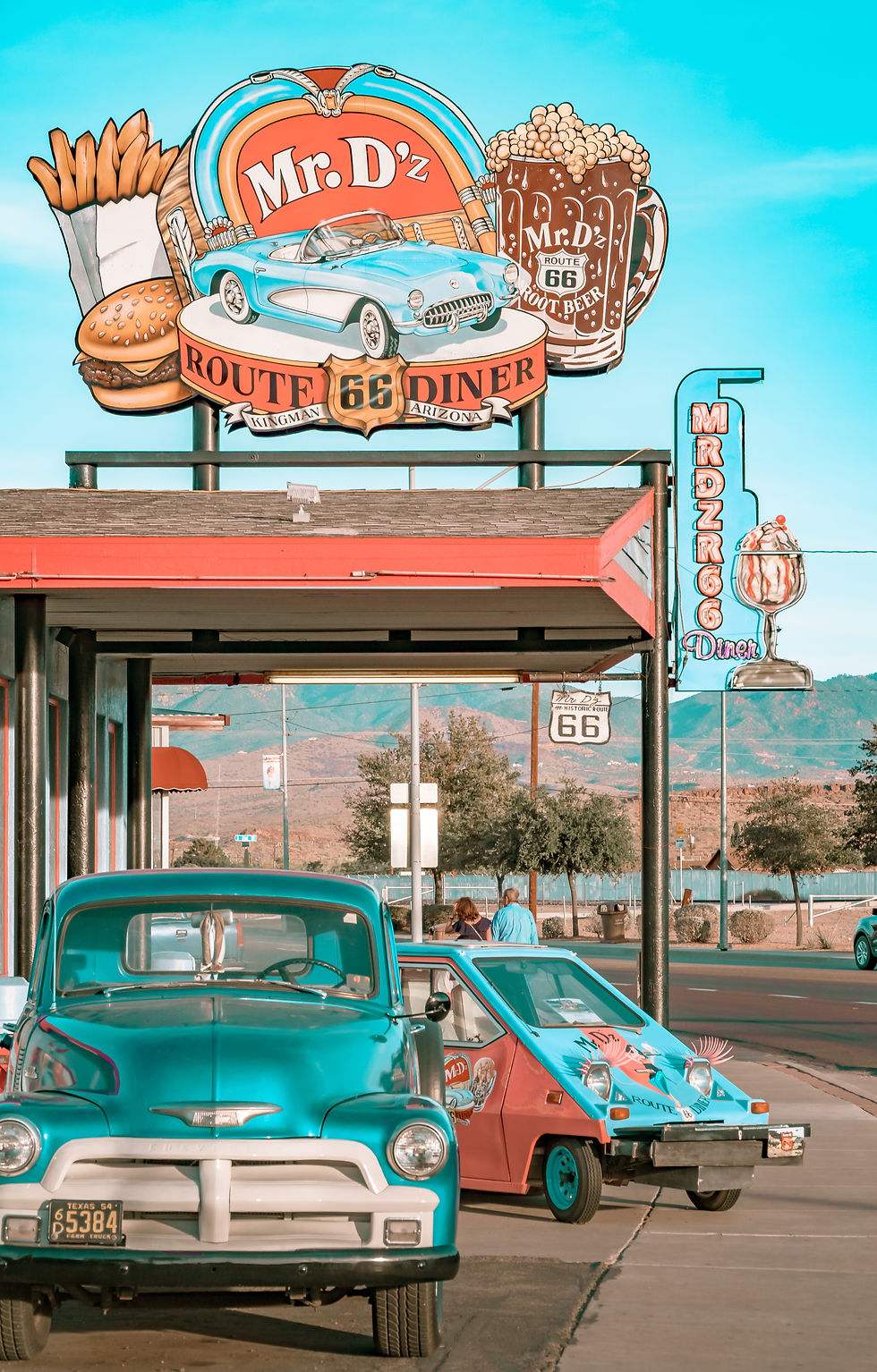
All eight Route 66 states have been coordinating a full year of programming around the 100th anniversary.
The national kickoff unfolded in Springfield, Missouri — the Birthplace of Route 66, where Cyrus Avery's telegram accepting the name "66" was sent on April 30, 1926.
Events continue through the fall: a classic-car parade through Tulsa on May 30, a centennial festival in Amarillo through June 13, and on November 11 itself, celebrations back in Springfield and a concert at Cain's Ballroom in Tulsa.
Between Trips Travel recommends booking now — iconic properties along the route are filling out for anniversary-adjacent dates well in advance.
The only honest way to drive it
The road has been rushed and that is not a compliment. Driving Route 66 in a week means driving the interstates that replaced it. The version that actually honors the journey is 21 days, at 100 to 150 miles a day — slow enough to stop for the neon motor courts, the fried onion burger, the canyon view, the inexplicably perfect slice of pie.
Drive west. Chicago to Santa Monica is the song's direction, the migrants' direction, and the cinematographic one: midwestern green rolls into Oklahoma red mesa, then Texas panhandle sky, then New Mexico light, then Arizona canyon and desert, then Pacific fog. You arrive at the water, and it feels earned.
Days 1–3: Illinois

The journey begins at the corner of Adams Street and Michigan Avenue in Chicago, beneath the Begin Route 66 marker.
Illinois delivers its pleasures steadily over 300 miles.
Pontiac has the free Route 66 Hall of Fame & Museum and 28 downtown murals.
Springfield has the Cozy Dog Drive In, where the corn-dog-on-a-stick was invented in 1946, and the Ariston Café in Litchfield — open since 1924 — is a strong case for never eating at a chain restaurant again.
Days 4–6: Missouri and Kansas

St. Louis means the Gateway Arch and Ted Drewes Frozen Custard on Chippewa Street, where the famous "concretes" have been served upside-down since 1929 to prove they won't move.
West of the city, Cuba, Missouri has reimagined itself as the Mural City — 15 outdoor murals, each with a QR code — and is home to the Wagon Wheel Motel, built in 1934, the oldest continuously operating motor court on the entire route.
Springfield deserves a full day for its new Birthplace Plaza, which marks the exact corner where the road was named.
Kansas is thirteen miles of pure reward: the tow truck that inspired Pixar's Tow Mater in Galena, the century-old Riverton Store, and the Marsh Arch Bridge in Baxter Springs.
Days 7–10: Oklahoma

Tulsa deserves two nights. The Cyrus Avery Centennial Plaza anchors the city with its bronze "East Meets West" sculpture, and the Meadow Gold Sign on 11th Street is the largest neon installation on the entire route.
Buck Atom's Cosmic Curios on 66 — a 1950s gas station fronted by a 21-foot Space Cowboy — is the centennial year's most entertaining stop.
In Arcadia, the 1898 Round Barn is the only circular barn on Route 66, and Pops 66 Soda Ranch, with its 66-foot LED soda bottle and 700 varieties of pop, makes absolutely no sense and complete sense simultaneously.
The deepest single meal on the road may be in El Reno, where the Depression-era fried onion burger — paper-thin Spanish yellow onions pressed directly into the patty as it cooks — has been served at Robert's Grill since 1926. Order it. Don't think about it.
Days 11–12: Texas
Texas is short and dense. Shamrock's U-Drop Inn is the most photogenic Art Deco filling station on the road, a 1936 terra-cotta landmark whose café reopened in February 2025.
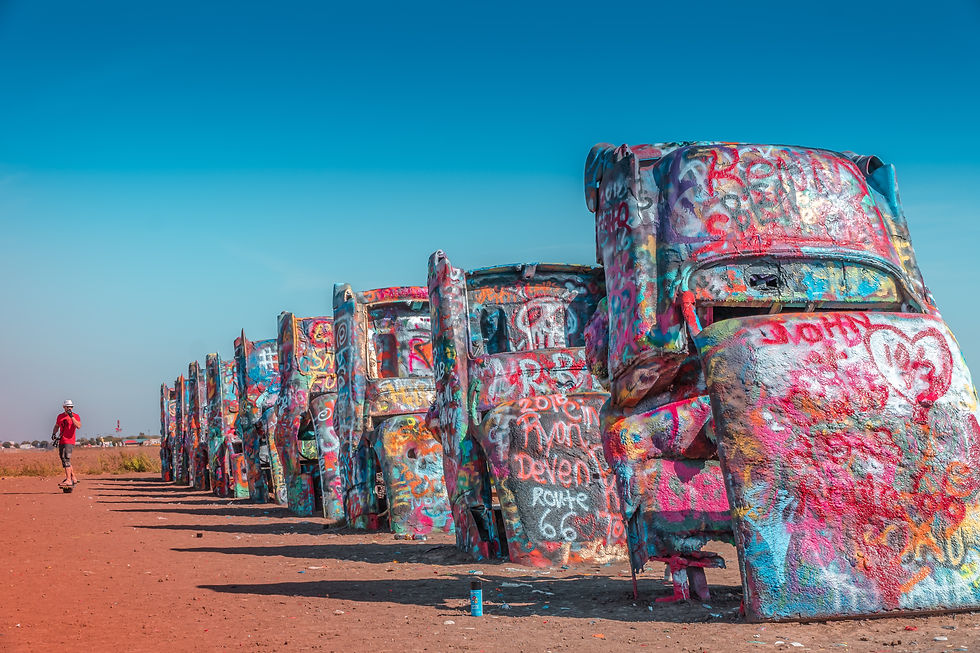
In Amarillo, Cadillac Ranch remains free, open 24 hours, and actively encourages spray paint: ten Cadillacs buried nose-down in a wheat field since 1974, still managing to be genuinely strange.
The Midpoint Café in Adrian marks the geographical heart of the route: 1,139 miles to Chicago, 1,139 to Santa Monica. The Ugly Crust pie is the whole point. Note that the Midpoint typically closes November through February — if November 11 is your target date, sequence Texas in October.
Days 13–15: New Mexico
Tucumcari contains the most concentrated stretch of restored vintage neon motor courts anywhere on the road — the kind of place that makes you understand why people have been driving this route for a hundred years. Walk out after dinner and simply look at the light.
The road west offers a choice: follow the post-1937 alignment straight to Albuquerque, or take the pre-1937 Santa Fe Loop through Las Vegas, New Mexico and Santa Fe — a 100-mile detour that adds a full day and earns every minute of it.

The state ends in Gallup, where the El Rancho Hotel, built in 1936, hosted more than 150 Hollywood stars during the Western-shooting era. The two-story fireplace lobby, the split-log staircases, the rooms named for John Wayne and Katharine Hepburn: it is a film set you can sleep inside.
Days 16–19: Arizona
If Route 66 has a holy land, Arizona is it — and it deserves the most time of any state.
Winslow anchors the middle of the route, with the Standin' on the Corner Park drawing visitors from around the world.
The Petrified Forest National Park contains an original stretch of Route 66 roadbed, marked by telephone poles and a rusting 1932 Studebaker. Holbrook's Wigwam Motel — 15 concrete teepees in family hands since 1950 — is one of the route's most photographed stops.

Then comes Seligman — where a barber named Angel Delgadillo watched the interstate bypass his town in 1978, organized the meeting in 1987 that founded the Historic Route 66 Association of Arizona, and catalyzed the historic designations that now exist in all eight states.
Without Seligman, the Route 66 100th anniversary road trip does not exist.
His family still runs the gift shop in his old barbershop. His brother's Snow Cap Drive-In still serves cheeseburgers with deliberately wrong condiments, and has since 1953.
The state closes with the Sitgreaves Pass — 191 curves through eight miles of the Black Mountains — and descends into Oatman, where wild burros roam Main Street and the 1902 Oatman Hotel preserves the room where Clark Gable and Carole Lombard spent their wedding night in 1939.
Days 20–21: California
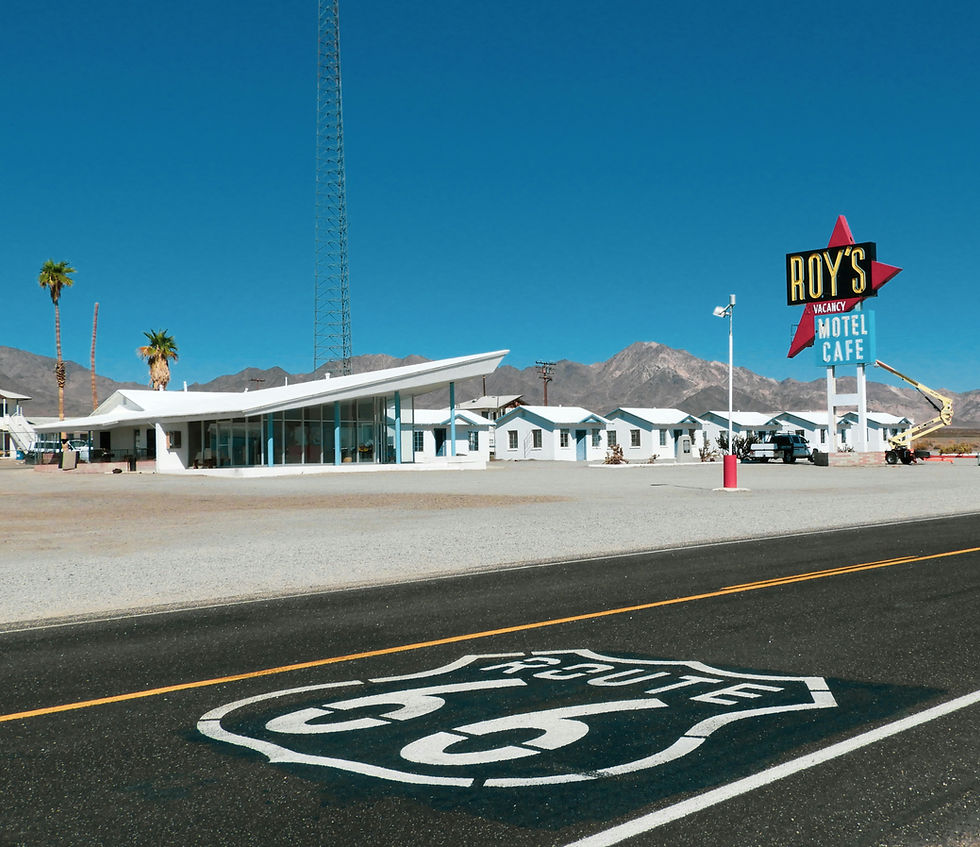
Top up the tank before leaving Arizona — fuel across the Mojave Desert is expensive and scarce. Roy's Motel and Café in Amboy, its 50-foot Googie neon sign relit in 2019, is the photograph of the trip regardless of what is or isn't open.
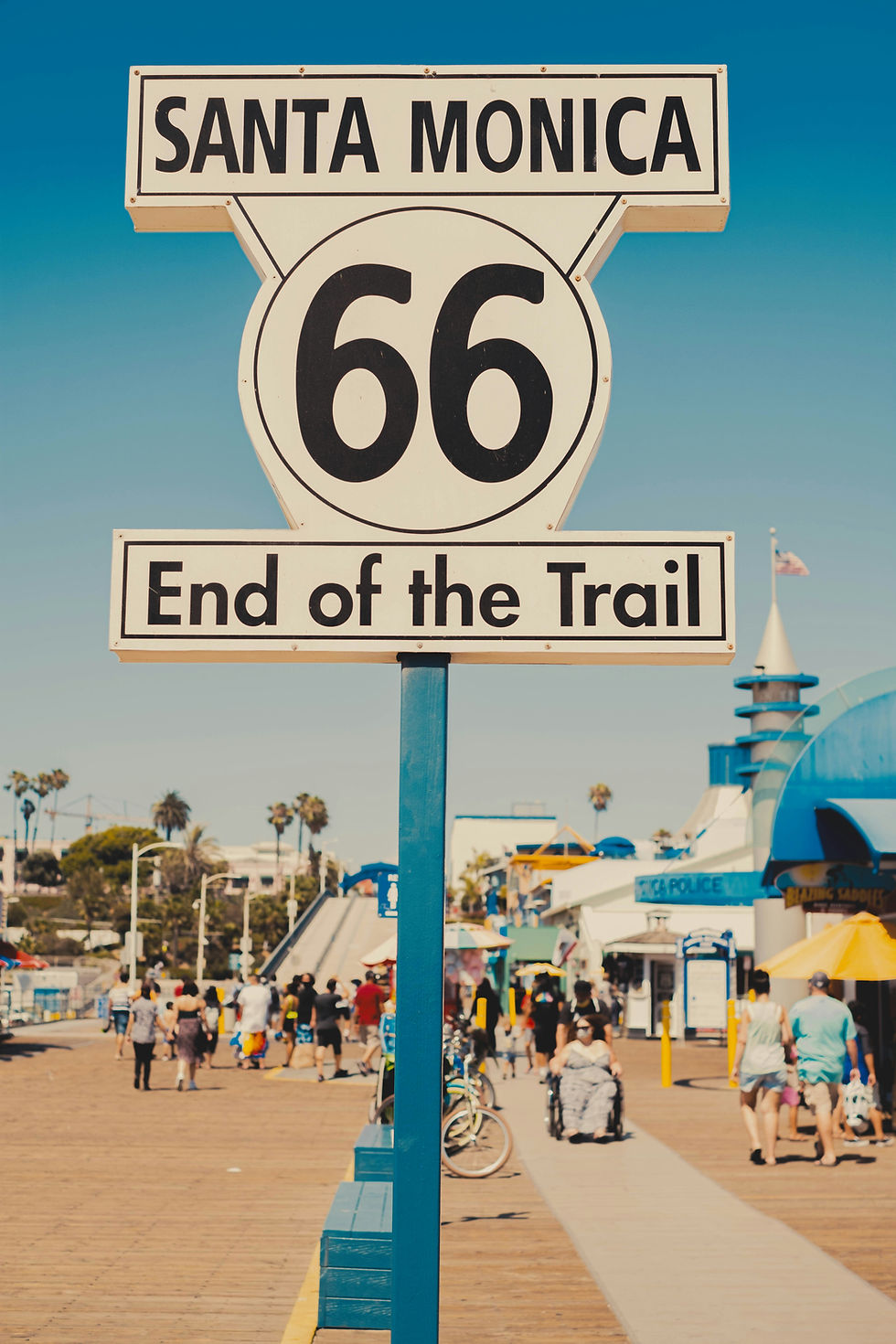
The road ends at the Santa Monica Pier. Stand at the water. The Pacific was always the point.
Before You Go: Your Route 66 100th Anniversary Road Trip Questions Answered
What's the best time to drive Route 66 in 2026?
The strongest remaining windows this year are late May through early June and mid-September through mid-October, when temperatures ease across the desert states and the road is alive with anniversary programming.
If reaching Tulsa or Springfield for the November 11 anniversary events is the goal, Between Trips Travel recommends driving the western states in October and the eastern states in early November. Avoid July and August in the Mojave and New Mexico, where summer heat regularly exceeds 100°F and afternoon monsoons bring flash flooding through Arizona.
How many days do you actually need?
Fourteen days is the minimum for a meaningful drive. Twenty-one days at 100 to 150 miles per day is the version that honors slow travel — and leaves room for the second night in Tucumcari, the afternoon detour to Santa Fe, the pie in Adrian. Travelers who push through in a week are driving the interstates that replaced the road.
Do you need a special vehicle?
A standard car handles everything except the Sitgreaves Pass into Oatman, which is not suitable for RVs or very low-clearance vehicles. A classic American car or convertible is a mood choice, not a practical requirement — though it is an exceptionally good mood choice.
How do you navigate the historic alignment?
Jerry McClanahan's EZ66 Guide for Travelers (5th edition) is the most reliable print guide on the market. The Route 66 Navigation app provides offline turn-by-turn for the many dead zones. Standard GPS navigation defaults consistently to the interstate — do not rely on it for historic alignment routing.
Is the full route drivable?
Roughly 85 percent of the original alignment remains drivable. The EZ66 Guide clearly marks impassable or unpaved segments. No section of the main alignment requires four-wheel drive.
The road that rewards patience
A Route 66 100th anniversary road trip is not something you complete. It is something you receive — slowly, over 2,448 miles of neon and pie and concrete teepees and people who simply refused to let their piece of this road disappear.
A century on, the Mother Road is still rolling.


