
Where the Jungle Meets the Taj: India's Golden Triangle

From Kipling's jungle to the marble glow of the Taj Mahal, this journey through India rewards every early morning and every long, winding road.
India does not ease you in gently. It arrives all at once — the colors, the sounds, the scent — and somewhere between the first jeep safari and the last sunrise, it rearranges something in you. The country took hold of me — and never quite let go.

What stays with you most is not a monument. It is the people: proud, generous, and genuinely delighted that you have traveled so far to visit.
Outside the major cities especially, strangers invite you in, want to share what they have, and ask to take a selfie with you. At one monument, two women approached me and asked me to airdrop the photo so they could have it too. That warmth is the thread running through every moment of this journey.
A Country That Follows Its Own Rhythm
The drives between destinations — Jabalpur to Bandhavgarh, Jaipur to Agra, Agra to Delhi — are an experience in themselves, and travelers who arrive with open eyes rather than fixed expectations will find them quietly revelatory.
India asks something of you before it gives itself to you: leave your preconceived ideas of how life should look at the airport.
What matters here, how people move through the world, even what passes for a rule of the road — all of it operates by a logic entirely its own. A dirt street swept spotless in front of a crumbling wall. Traffic flowing through what appears to be beautiful chaos, somehow without incident — equal parts terrifying and mesmerizing. The longer you watch, the more sense it makes.

What you will see through the window is a country in vivid motion. Saris add color to everything — in town and in the countryside, on a motorcycle weaving through traffic and in the fields at dusk.
Cows, considered sacred, move through intersections at their own pace, and traffic simply adjusts around them. It is not a performance. It is daily life, playing out to a completely different rhythm than our own.
These drives also make plain the sheer vastness of the country. A couple of weeks allows you to see only a small portion of India — and that realization does not disappoint. It invites you back.
Two Cities, One Delhi
Delhi is really two cities pressed together, and the contrast is inseparable from its appeal.
New Delhi — wide, tree-lined, laid out in the orderly geometry of British colonial planning — feels navigable, even familiar to seasoned travelers. Landmarks like India Gate, Humayun's Tomb, and the gracious grounds of Lodi Gardens reflect a city that wears its history with a certain composure.

Old Delhi operates by entirely different rules.
Near the spice market lanes of Chandni Chowk, the streets narrow until only rickshaws, motorcycles, and pedestrians can pass. Tiny storefronts crowd together, the air is layered with cumin and cardamom, and every corner reveals another pocket of life operating at full volume.
Plan at least three days here to begin to understand both faces of this city. A single day leaves you with more questions than answers, and Delhi deserves better than a passing impression.
Into Kipling's Jungle: Bandhavgarh National Park
After the long, rewarding drive from Jabalpur, The Oberoi Vindhyavilas announces itself as exactly the kind of place you hoped was waiting. Set within Bandhavgarh National Park in Madhya Pradesh, the property earns the word oasis in every sense.
The luxury tents look out over private garden spaces, each window a quietly beautiful view onto nature. The pool is exceptional, the spa and yoga program restorative, and the overall feeling is of a place designed to restore you — and then send you back into the wild.

The wild, here, is extraordinary. Bandhavgarh holds the highest density of tigers in all of India, and it is the jungle that served as Rudyard Kipling's inspiration for The Jungle Book. That detail adds a particular atmosphere to every early morning drive through the forest, where the light filters through teak and sal trees and anything might be watching from the undergrowth.
During my time in the park, tigers appeared on three separate safaris — twice crossing the road a mere 10 to 20 yards from our jeep. Watching a tiger move through its own landscape, unhurried and entirely sovereign, reframes every zoo visit you have ever made. The word that comes back, again and again, is humbling — and magical.

Wildlife extends well beyond tigers. An elephant emerged from a riverside bath and walked directly toward our jeep before turning unhurriedly into the jungle — a sighting that long-tenured lodge staff called rare.
Leopards, multiple species of deer, and bears also inhabit this remarkably intact forest ecosystem.
Go on both the morning and afternoon safaris. The light shifts dramatically between them, the animals move differently as the day changes, and each outing delivers its own unrepeatable encounter.
Between Trips Travel recommends three to four nights at Bandhavgarh to allow for unhurried safaris, genuine downtime at the resort, and the full arc of the wilderness experience.
Jaipur: From the Sky and the Table
On the evening of arrival, the sunset from the walls of Naila Fort offered a quieter kind of spectacle. Originally built in 1849 and now a beautifully restored Oberoi residence set just outside the city, Naila Fort is the kind of place that does not announce itself and does not need to. The sky's colors reflected off the stone and the gardens below in tones that shifted from gold to rose to amber as the light faded.

The following morning, my balloon lifted off at 5am — and it was exactly as worth it as that hour sounds reluctant to be.
The balloon inflated in the darkness, and then — gently, almost improbably — the ground fell away. The sensation is nothing like flying. It is more like becoming a soap bubble: suspended, weightless, drifting above a city still wrapped in the quiet before dawn. The Aravalli Hills appeared in the distance; the rooftops and temple spires of Jaipur receded below.

The landing delivered its own unexpected gift. The balloon set down in a field near scattered farmhouses, and local families came out with uncomplicated joy — wanting to know where everyone had come from, extending invitations for tea. A teenage girl and her grandmother were among them, warm and curious, happy simply to share the moment.
The schedule did not allow for tea — but the encounter stayed long after the flight certificate was tucked away.
Back on the ground, Jaipur earned its nickname — the Pink City — at every turn. The Hawa Mahal, or Palace of Winds, stops you in your tracks. Built in 1799 by Maharaja Sawai Pratap Singh, its five-story facade of 953 latticed windows was designed to allow the royal women of the court to observe street life below while remaining unseen — a stunning architectural solution to the customs of the time.

Nearby, the City Palace opens into a series of courtyards, museums, and royal apartments that speak to centuries of Maharaja rule. Amber Fort, reached by winding road above the city, is among the most commanding structures in all of Rajasthan. The textile markets and workshops woven through the city offer another layer entirely — color, craft, and a tradition of artisanship that predates the monuments themselves.
That evening, dinner at Dera Amer Wilderness Camp arrived by jeep along a forested track passing a medieval gate, a village school, and working agricultural farms. The host family — deeply committed to wildlife rehabilitation and land reclamation from what was once an overharvested landscape — welcomed their guests with the ease of people sharing something they genuinely love. The meal was local, beautifully prepared, and served at a candlelit table beneath an open tent. I left feeling exactly like an invited friend.

Between Trips Travel recommends spending the night at Dera Amer Wilderness Camp — waking up in the middle of that landscape makes everything that follows feel different.
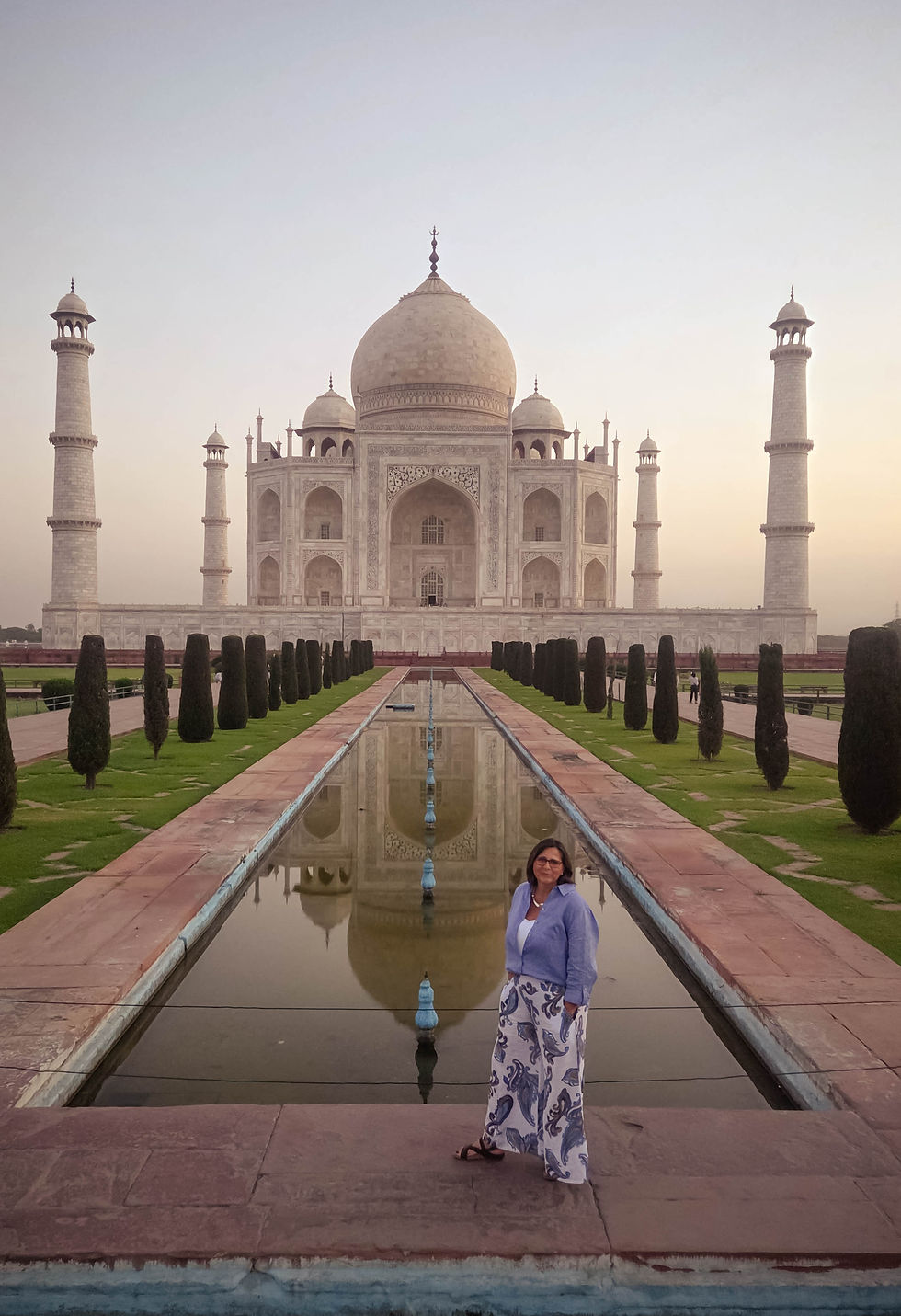
The Taj Mahal at Dawn
I arrived at the Taj Mahal in Agra just as the gates opened, in the unsoft stillness before the crowds. The white marble absorbed the early light and returned it in pale shades of pink and amber that deepened and shifted as the sun climbed. The first hour offered the monument at its most unguarded — and left me speechless.
Across the Yamuna River, the Oberoi Amarvilas keeps the Taj in view from every room, from the lobby, and from the terrace. It is the kind of view that renders commentary unnecessary.
This India Golden Triangle journey covers more than geography. From the spice-layered lanes of Old Delhi to the silence of Kipling's jungle to the pale glow of the Taj Mahal at dawn, each destination asks something different of the traveler and returns something unexpected in kind.
Before You Take the Road Through India
What is the best time to visit India's Golden Triangle?
October through February is the most comfortable window — warm days, cool evenings, and ideal conditions for both safari and sightseeing.
March and April bring rising temperatures that can reach 105°F or above, particularly across Rajasthan; the heat is dry rather than humid, which makes it manageable with early morning starts and midday rest.
The monsoon arrives in June and runs through September, transforming the landscape but limiting safari access at Bandhavgarh National Park.
For wildlife and golden triangle sightseeing combined, October through March is the sweet spot.
Do you actually see tigers at Bandhavgarh National Park?
Bandhavgarh National Park has the highest tiger density in India, and sightings here are more consistent than at almost any other reserve in the country. Both morning and afternoon safaris are strongly recommended. Wildlife encounters are never guaranteed, but the odds at Bandhavgarh are as favorable as anywhere in the world.
Is arriving at the Taj Mahal at sunrise worth the early start?
Without question. The marble shifts from pale pink to amber as the light changes, and the first hour after the gates open offers a sense of space and quiet that disappears quickly as the day progresses. Being back at the hotel for breakfast by 8am is entirely achievable.
How many days do you need for this itinerary?
For a journey covering Delhi, Bandhavgarh, Jaipur, and Agra, Between Trips Travel recommends fourteen to sixteen days minimum. Three full days in Delhi, three to four nights at Bandhavgarh, three days in Jaipur with a night at Dera Amer Wilderness Camp, and three days in Agra allows each destination the time it genuinely deserves.
Do I need a private guide and driver throughout?
Yes — and not only for convenience. Delhi's traffic is unlike most cities in the world, and self-driving is not recommended. The right tour operator manages everything from airport arrival through customs to seamless transfers between destinations, leaving you free to simply be present for whatever unfolds.
Your India Golden Triangle Awaits
India stays with you long after the last flight home. The tiger that crossed the road twenty yards from the jeep. The balloon lifting into a sky not yet light. The sun setting over the Yamuna with the Taj on the horizon. The women in the field who just wanted to share the moment.

These are not things you can plan for — but you can put yourself in their path.
We are ready to help you do exactly that.
Your India is waiting.


